De-escalation Pro
Training for K-12 educators
On-site de-escalation training to help educators calm situations before they grow more intense

SINCE 2002
Some of the organizations
we've worked with
Needham Public Schools
Longmeadow Schools
St. Michael's Academy
Postive Behavior Supports
ServiceNet
J.S. Bryant School
The Valley West School
Springfield Prep Charter
Petersham Public Schools
East Longmeadow Schools
Pathfinder Vocational
Ludlow Public Schools
Veritas Prep Charter
Central MA Collaborative
Embracing The Creative Child
Belchertown Schools
Orange Public Schools
Worcester Schools Busing
Ralph Mahar Regional
Hampshire Regional Schools
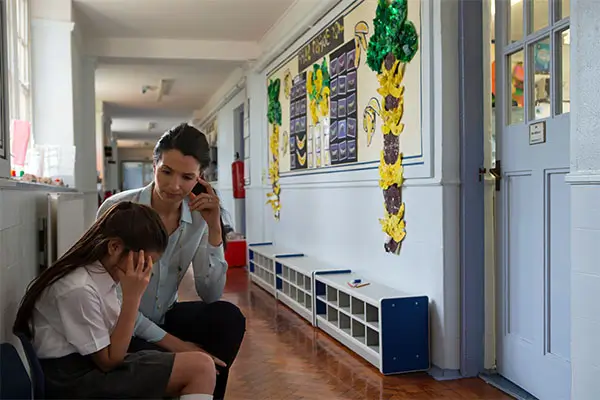
Effective De-escalation Helps Lead to...
Less Disruption to the entire building
When situations are resolved quickly, neighboring classrooms are less likely to be interrupted, and students are less likely to be moved out of their own rooms.
Reduction of property destruction
Quick resolution keeps theDe-escalated situations are less likely to reach the point where rooms, materials, and electronic devices are damaged.
Lower risk of staff injury
Bringing a situation down early can keep it from escalating to where a staff needs to physically intervene.
Ralph Mahar Regional
What We'll Cover With Your Staff
Looks at what de-escalation actually is, how it works, and how it differs from traditional behavior management. This can help staff recognize which situations call for which approach.
Introduces the core principles behind successful de-escalation. Staff who understand these foundations can apply them across any situation — not just the ones they've seen before..
Understanding these variables can help staff adjust their approach based on what's actually in play — so they aren't blaming themselves or their technique when something outside their control is driving the situation.
Looks at what's actually going on when someone escalates — physically, emotionally, and cognitively. Recognizing what's happening inside an escalated person helps with choosing responses that work with the escalation rather than against it.
Preparation done ahead of time, so tools and supports are ready to use the moment they're needed. When that preparation is already in place, de-escalation can start with resources rather than starting from scratch.
A method for quickly reading what may be causing an escalation. With a clearer read, responses can be matched to what's actually driving the situation rather than defaulting to a generic reaction.
How body language, positioning, and facial expression can shape a situation before words do — for better or worse. The wrong stance or gesture can escalate things on its own, while the right non-verbal cues can help calm someone down even when a staff member can't find the right thing to say.
The core skills and phrases used to help calm someone down. What to say, how to say it, and what to do while saying it. Staff with the right tools are less likely to reach for the wrong ones (ultimatums, threats, raised voice) that make situations worse.
When more than one staff member responds to a situation, things can either come together or fall apart. This section covers how to work alongside other staff without getting in each other's way — and how extra people in the room can support the effort rather than complicate it.
Common mistakes that can derail a de-escalation effort or drag it out far longer than it needs to go. Knowing what these look like ahead of time can help staff spot them before they do damage — including ones they might be doing without realizing it.
What happens after a student calms down matters as much as how the situation was handled in the moment. This section covers the work that comes next — for the student, for the staff involved, and for the rest of the day — and why skipping it can set the stage for the next incident.
De-escalation puts staff in close proximity to someone who may be physically unpredictable. This section covers how to reduce the chances of injury during the process — from positioning and spacing to reading warning signs that a situation may be turning physical.
READY TO GET STARTED?